

Deadwood Dick and other African American Cowboys

“Few images embody the spirit of the American West as well as the trailblazing, sharpshooting, horseback-riding cowboy of American lore. And though African-American cowboys don’t play a part in the popular narrative, historians estimate that one in four cowboys were black.” smithsonianmag.com

During the Civil War many Texan ranchers left to fight alongside their fellow confederate men in the East. During this time, they depended on their slaves to look after and maintain their land and cattle, resulting in many slaves developing cattle hand skills. With the confederacy losing the civil war and with the Emancipation Proclamation, ranchers had no choice but to hire free African Americans. With their new skills in herding cattle, they found themselves to be in great demand when ranchers began selling their livestock to northern states. It is estimated that as many as one in four cowboys were African American, working to round up herds on horseback, travel unforgiving terrains and fend off attacks from Native Americans.
One famous cowboy named Nat Love was born in 1854 on Robert Love’s plantation in Tennessee and into slavery. After the civil war, and after his Father’s death, a young Nat took various jobs on plantations to support his family and found he had a special skill with breaking horses. At the age of 16 years old, Nat left his family in his uncle’s care and headed to the Wild West.

Nat ended up in Dodge City, Kansas where he proved himself by breaking the ‘wildest horse’ on the Duval Ranch and so landed a job with them. The young boy quickly adapted to the cowboy life excelling as a ranch hand and practicing his shooting skills. After 3 years with the Duval Outfit and getting a reputation for best ‘all round’ cowboy, Nate moved to Arizona. His skills landed him a job with another ranch on the Gila River, here he travelled many western trails, fought off many native Americans and bandits and lived up those typical Wild West cowboy days. As an Arizona cowboy he was given the name ‘Red River Dick’ and claimed to have met many famous men of the Old West including Billy the Kid.
In 1876 his outfit were sent to deliver a herd to Deadwood, South Dakota where Nat entered a cowboy competition which consisted of roping, bridling, saddling and shooting. The winner would get a $200 cash prize. Nat walked away with the cash prize and the new name ‘Deadwood Dick.’
Nat continued to work as a cowboy in the south west for another 15 years. In 1907 he published an autobiography The Life and Adventures of Nat Love, Better Known in the Cattle Country as “Deadwood Dick.” Whilst Nat claims his biography to be true it is rather seen as a dime novel. Read it here.
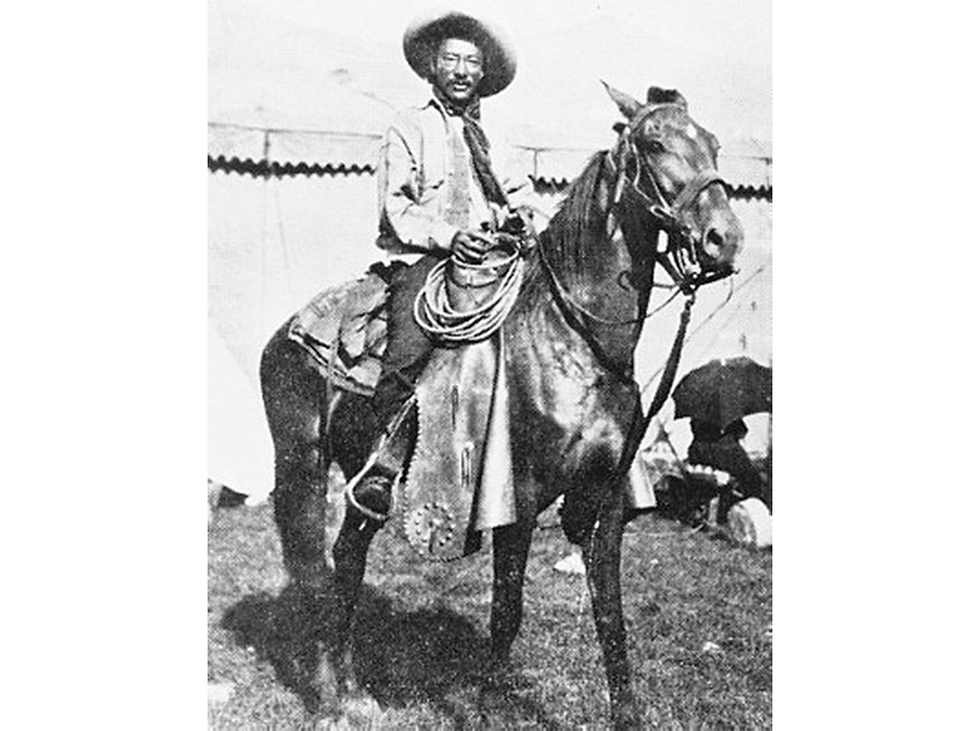
As the railroad became the main mode of transportation, the cattle drives, and with it the old western cowboy, began to disappear. However, the publics fascination with them did not. Many tales and Wild West shows and rodeos started to appear across the country. Bill Pickett, born in 1870 Texas to former slaves went on to be one of the most famous early rodeo stars. Bill became famous for his unusual method of catching stray cows based on his observations on ranch dogs. Bill would control a steer by biting its lip which subdued the cow, a trick he performed for audiences all around the world with the 101 Wild Ranch Show. The trick better named as ‘bulldogging.’40 years after Bill’s death, he became the first black honoree in the National Rodeo Hall of fame.
Cleo Hearn, another rodeo star to make history has been a professional cowboy since 1959.

In 1970, he became the first African American cowboy to win a calf-roping event at a major rodeo. He was also the first African American to attend college on a rodeo scholarship.
Cleo has been featured in commercials for Ford, Pepsi-Cola and Levi’s, and was the first African-American to portray the iconic Marlboro Man. However, everyone wasn’t always as accepting of the black cowboy, he recalls being barred from entering a rodeo in his hometown in Oklahoma, when he was 16 years old because of his race.
In 1971 Cleo started producing rodeos for people of color. His Cowboys of Color Rodeo recruits cowboys and cowgirls from diverse racial backgrounds and boasts over 200 athletes who compete at multiple rodeos throughout the year including the famous Fort Worth Stock Show. Check out his story here.
Sources
https://www.legendsofamerica.com
https://www.smithsonianmag.com
https://www.greatbigstory.com

Comments